
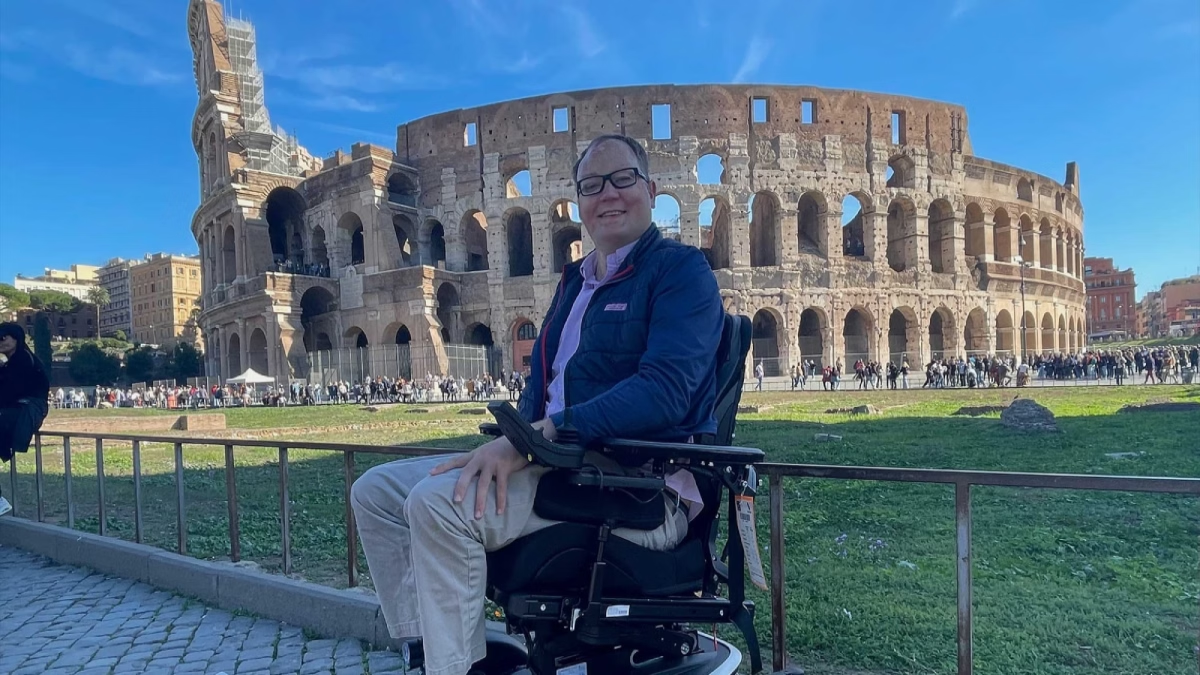
Colosseum Accessibility Guide: Wheelchairs, Lifts & Disabled Visitor Information

The Colosseum is partially accessible for visitors with mobility needs. The main accessible entrance is the Sperone Valadier entrance (no stairs, flat access). An elevator connects the ground floor to the first and second levels, accommodating two wheelchairs at a time. The underground chambers and upper Attic levels (3rd tier and above) are not wheelchair accessible due to stairs and narrow passages. One accompanying carer enters free with a disabled visitor.
Planning a visit to the Colosseum with mobility needs requires a little extra preparation — but it is entirely possible to have a meaningful and rewarding experience. This guide covers exactly what is accessible, what is not, how to enter, where the elevator is, what to bring, and what to request before your visit. It is written for visitors with wheelchairs, mobility aids, or limited mobility, as well as for carers and travel companions planning on their behalf.
Top Tickets
The General Entry ticket lets you explore at your own pace, while the Guided Tour adds an expert guide to the Colosseum, Roman Forum, and Palatine Hill. Want to stand on the arena floor? Go for the Guided Tour + Arena. For the full experience including the underground hypogeum, the Arena + Underground is the one to book.
Table of Contents
Summary: What Is and Isn’t Accessible
| Area | Wheelchair Accessible? | Notes |
| Sperone Valadier entrance | Yes | Main accessible entrance — no stairs, flat access |
| Ground floor (exterior walkway) | Mostly yes | Some ancient cobblestone surfaces |
| First level (first tier) | Yes (via elevator) | Elevator accommodates 2 wheelchairs |
| Second level (second tier) | Yes (via elevator) | Elevator accommodates 2 wheelchairs |
| Underground / Hypogeum | No | Stairs and narrow passages only |
| Attic (4th–5th levels) | Partial | Panoramic lift available but surfaces uneven at top |
| Roman Forum | Mostly yes | Some uneven ancient surfaces |
| Palatine Hill | Partially | Steep in sections; some paths accessible |
| Colosseum Museum (Level 2) | Yes (via elevator) | Full museum access on accessible levels |
The Accessible Entrance
The main accessible entrance to the Colosseum is the Sperone Valadier entrance, located on the northeast side of the building. This entrance has no stairs and provides direct flat access to the ground floor. It is the standard entrance for all general entry ticket holders as well as visitors with disabilities and their carers.
The Sperone Valadier entrance is located on the northeast side of the Colosseum, approximately 100 metres from the Colosseo metro station exit. There are no steps or barriers at this entrance, and the threshold is flat and wide enough for standard wheelchairs. Once inside, accessible routes are signposted.
Visitors with disabilities and their carers should not use the Stern Entrance (which serves guided tours to restricted areas) — this entrance has steps. The Group Entrance also has steps and is not recommended for wheelchair users. Use the Sperone Valadier entrance only.
The Colosseum Elevator
The Colosseum has an elevator that connects the ground floor to the first and second levels. The elevator accommodates a maximum of two standard wheelchairs at a time and requires assistance from Colosseum staff to operate. It is located inside the monument near the Sperone Valadier entrance. The elevator does not reach the underground chambers or the upper Attic levels.
The elevator gives wheelchair users access to the first and second tiers of the Colosseum — the primary viewing areas that most general entry ticket holders see. From these levels you get the full panoramic view of the interior, including the exposed hypogeum (underground) below and the rising tiers of seating above.
Important practical note: The elevator accommodates a maximum of two wheelchairs at a time. During busy periods, there may be a wait of 10–20 minutes to use it. Staff are present to assist. We recommend visiting early in the morning (at opening, 8:30 am) to minimise wait times at the elevator.
Wheelchair Loan Service
The Colosseum offers a wheelchair loan service on a first-come, first-served basis. Wheelchairs are available to borrow at no charge from the ground floor reception and security office near the Sperone Valadier entrance, and from the Roman Forum entrances. Availability cannot be guaranteed — bring your own if you require one.
If you are uncertain whether you will need a wheelchair throughout the visit, the loan service is a useful option. However, as availability is limited and first-come, first-served, we recommend bringing your own wheelchair or mobility aid if at all possible — particularly for visits during peak season (June–August) when demand is highest.
Companion / Carer Free Entry
One accompanying carer or companion enters the Colosseum free of charge with each disabled visitor. You must present proof of disability status at the entrance — an official disability certificate or documentation, together with valid photo ID. The companion’s free ticket must still be booked in advance through the official website alongside the disabled visitor’s ticket.
When booking, select the disabled visitor ticket option on the official Colosseum website (ticketing.colosseo.it). The companion ticket is then available as a free add-on. Both tickets — the disabled visitor ticket and the companion ticket — must be booked together and in the visitor’s name. Do not book separately and attempt to claim the companion discount at the gate.
What to Bring
- Proof of disability status: Official documentation (certificate, EU disability card, or equivalent national documentation). Required to access the disabled visitor ticket rate and companion free entry
- Valid photo ID: Passport or national ID card — required at the entrance for all visitors
- Your pre-booked ticket: On your phone or printed. Do not rely on being able to buy at the gate
- Your own wheelchair or mobility aid: If you require one — the loan service is first-come, first-served
- Water: Sealed plastic bottles are permitted through security
- Comfortable shoes: Even for wheelchair users, companions should wear non-slip, comfortable footwear — some surfaces are uneven ancient stone
Accessible Areas in Detail
Ground Floor
The ground floor consists primarily of the outer walkway surrounding the arena. The floor is ancient cobblestone in many sections — uneven but generally manageable with a standard wheelchair and carer assistance. Some sections have been resurfaced with smoother material. The route around the perimeter is clearly marked.
First and Second Levels (via Elevator)
Once on the first level via the elevator, wheelchair users can access the main viewing galleries overlooking the arena floor. The floors here are predominantly flat, with some minor transitions. The second level offers a different perspective and the Colosseum Museum is located here — fully accessible via the elevator.
Colosseum Museum
The Colosseum Museum is located on the second level and is fully accessible to elevator users. It contains artefacts, models, and historical displays about the Colosseum’s construction and history. No additional ticket is required — it is included in all Colosseum tickets.
Underground / Hypogeum — Not Accessible
The underground chambers (hypogeum) are accessed via a staircase and involve narrow corridors, uneven surfaces, and changes in level throughout. They are not accessible for wheelchair users or visitors with significant mobility impairments. Underground tours require the ability to navigate stairs and tight spaces.
Attic Levels — Partial Access
The Colosseum Attic (4th and 5th levels) is reached via the panoramic lift, which is accessible. However, some areas at the Attic level have uneven ancient stone surfaces that may be difficult for some wheelchair users without carer assistance. Contact the Colosseum directly (colosseo.it) for the most up-to-date information on Attic accessibility before booking the Full Experience Attic ticket.
Roman Forum
The Roman Forum, included in all Colosseum tickets, has multiple entrances and is largely flat at ground level. However, the ancient paving (sampietrini and Roman stone) is uneven in places, and some pathways between ruins involve steps. Wheelchairs borrowed from the Roman Forum entrances (first-come, first-served) are available. The main accessible entry points are Via Sacra and the entrance near the Arch of Titus.
Palatine Hill
The Palatine Hill, also included in all Colosseum tickets, is more challenging for wheelchair users due to the hill’s gradient. Several paths are accessible but the full circuit requires significant elevation change. Partial exploration — particularly the lower gardens and accessible terraces — is possible. Ask at the Forum entrance for the current accessible routes.
Tips for Visitors with Disabilities
- Book early morning time slots: 8:30–10:00 am has the shortest elevator queues and smallest crowds — particularly important for those who tire easily or need more time
- Allow extra time: Security, elevator queues, and navigating ancient surfaces all take longer than standard visitor times suggest. Add 30–45 minutes to your planned duration
- Contact the Colosseum in advance: For specific needs (medical equipment, specialist wheelchairs, guided assistance), email the Colosseum’s visitor services before your visit via the contact form on colosseo.it
- Consider a private tour: A private tour allows fully customised pacing and can be arranged with accessibility needs discussed in advance with the operator
- Avoid peak crowds: See our guide to how to avoid crowds at the Colosseum — lower crowds mean less pressure and more space to navigate comfortably
- Accessible toilets: Accessible restrooms are available on both the ground floor and second floor. Look for signboards inside the monument
Getting to the Colosseum with Mobility Needs
The nearest metro station is Colosseo on Metro Line B, which has elevator access. From the station exit, the Colosseum is approximately 100 metres ahead. The route from the metro exit to the Sperone Valadier entrance is flat and on a paved surface — no significant obstacles.
Taxis and accessible vehicles (including those serving visitors with disabilities) can drop off at Piazza del Colosseo. For driving directions and accessible parking, see our guide to getting to the Colosseum.
Frequently Asked Questions
Is the Colosseum wheelchair accessible?
Partially. The main Sperone Valadier entrance is step-free, and an elevator connects the ground floor to the first and second levels. The underground chambers are not accessible due to stairs and narrow passages. The Attic levels have a panoramic lift but some uneven surfaces at the top.
Is there an elevator in the Colosseum?
Yes. An elevator near the Sperone Valadier entrance connects the ground floor to the first and second levels. It accommodates a maximum of two standard wheelchairs at a time and requires staff assistance to operate. The elevator does not reach the underground or Attic levels.
Can visitors with disabilities get a free companion ticket?
Yes. One accompanying carer enters free with each disabled visitor. Both the disabled visitor ticket and the companion ticket must be booked in advance through the official website. Proof of disability status is required at the entrance.
Can I borrow a wheelchair at the Colosseum?
Yes. Wheelchairs are available to borrow for free at the ground floor reception near the Sperone Valadier entrance and at the Roman Forum entrances. Availability is first-come, first-served and cannot be guaranteed. Bring your own if possible.
Is the Colosseum underground accessible?
No. The underground chambers (hypogeum) are not accessible for wheelchair users or visitors with significant mobility impairments. Access involves a staircase descent and narrow, uneven underground corridors.
Which Colosseum entrance is accessible?
The Sperone Valadier entrance on the northeast side of the Colosseum is the main accessible entrance. It has no stairs and flat access to the ground floor. Do not use the Stern Entrance or Group Entrance — both have steps.
How do I book a disabled visitor ticket?
Disabled visitor tickets are booked through the official Colosseum website (ticketing.colosseo.it). Select the ‘reduced’ or ‘disabled’ ticket category and add the companion ticket as a free addition. Both tickets must be in the visitor’s name and booked together. Proof of disability documentation is required at the entrance.
Related Guides
- Colosseum Entrances — Which to Use for Your Ticket
- How to Get to the Colosseum — Transport Guide
- Colosseum Ticket Prices & Free Entry
- Colosseum with Kids — Family & Accessibility Guide
- Private Colosseum Tours — Fully Customisable Pace
- Colosseum Bag Rules & Security
- Tips to Avoid Crowds at the Colosseum
